Wooden Push Walker & Blocks for First Steps (Toddler)
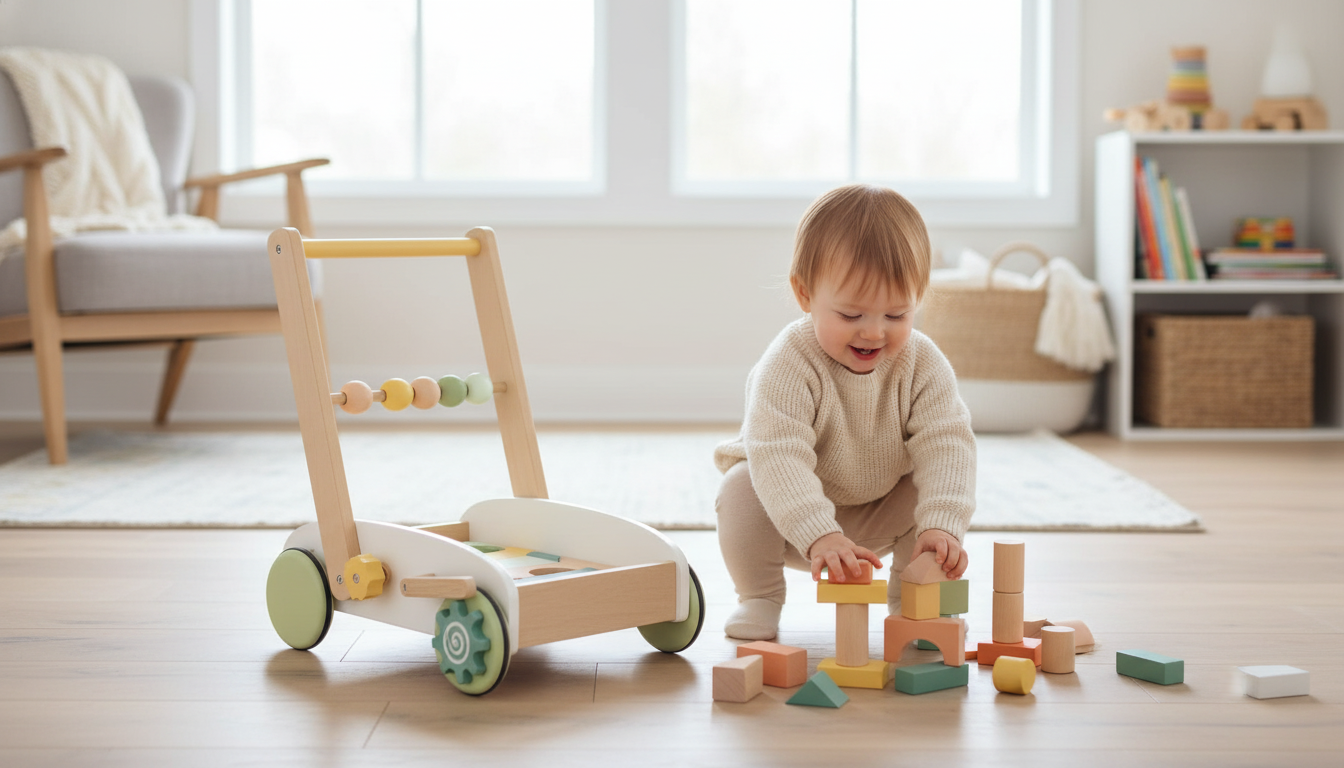
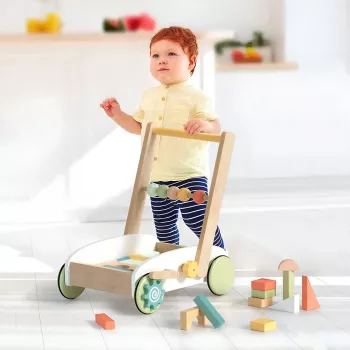
Wooden Baby Push Walker with Blocks for Toddlers Learning to Walk
A sturdy push walker can help toddlers practice balance while giving little hands an engaging activity. This wooden push walker includes blocks for open-ended play, supporting early walking practice, coordination, and confidence during everyday floor time.
Unlike sit-in baby walkers (the kind a child sits inside), a push walker is designed for a toddler to stand behind and hold on while moving. Pediatric safety organizations strongly discourage sit-in baby walkers due to fall and injury risks, while supervised push toys can be a safer, development-friendly option for many families when used correctly on flat floors.
What this push walker set includes
- Wooden push walker designed for early walkers to hold, push, and steer across flat floors.
- Included blocks for stacking, sorting, and pretend play during breaks from walking practice.
- A stable frame that encourages upright posture while cruising and taking steps.
- A play-and-move setup that can keep toddlers engaged longer than a simple walker alone.
Because the blocks are part of the play routine, toddlers can naturally switch between “move” time and “build” time—helpful for little ones who get frustrated if walking practice feels too repetitive.
Why wooden push walkers are popular for early walkers
- Heavier feel than many plastic walkers, which can help reduce tipping and sudden speed-up on smooth floors.
- Natural material aesthetic that fits playrooms and nurseries without looking overly busy.
- Pairs movement practice with fine-motor play, since blocks encourage grasping, stacking, and controlled release.
- Encourages independent play: toddlers can alternate between walking practice and block play without needing a separate toy.
If you’re comparing different “walker” options, it’s worth noting the distinction highlighted by the American Academy of Pediatrics: push toys are not the same as sit-in baby walkers, and the safety concerns that apply to sit-in devices don’t translate 1:1 to a supervised push walker used on a flat surface.
Skills supported during play
- Gross motor: balance, leg strength, and coordinated stepping while pushing.
- Core stability and posture practice through upright movement.
- Fine motor: picking up blocks, transferring hand-to-hand, stacking, and releasing with control.
- Cognitive play: experimenting with cause-and-effect (push, stop, turn) and simple problem-solving with blocks.
- Social-emotional: confidence building as toddlers practice movement goals at their own pace.
Many families like to pair a push walker with a general understanding of early movement milestones. For a quick reference on typical movement development, the CDC milestones guide is a helpful overview (keep in mind that timelines vary widely from child to child).
Everyday safety and setup tips
- Use on a flat surface; avoid stairs, uneven thresholds, and steep ramps.
- Clear the path of throw rugs and clutter to reduce sudden stops and tumbles.
- Supervise early sessions, especially while toddlers learn to turn and stop.
- Check hardware and wheels regularly for tightness and smooth rolling.
- Choose grippy footwear (or grippy socks) if floors are slippery.
| Checkpoint | What to look for | How often |
|---|---|---|
| Play area | No stairs access; clear, flat path | Every session |
| Walker stability | No wobble; frame sits evenly | Weekly |
| Wheels | Roll smoothly; no cracks or sharp edges | Weekly |
| Blocks | No splinters; intact paint/finish | Weekly |
| Supervision | Close watch during turning and speed changes | Every session |
For broader toy safety reminders—such as checking for damage, keeping age-appropriate small pieces away from younger siblings, and monitoring wear over time—the U.S. Consumer Product Safety Commission (CPSC) toy safety guidance is a useful reference.
Ways to play with the blocks while practicing walking
- “Park and build”: push the walker to a spot, then stack blocks for 1–2 minutes before moving again.
- Color/shape hunts: place a few blocks ahead and push the walker to “deliver” them.
- Balance challenge: carry one block at a time to encourage controlled starts and stops.
- Pretend play: use blocks as “groceries” or “mail” to make cruising and walking feel like a game.
These mini-games can be especially helpful when a toddler is building confidence—short bursts of movement, a quick success with blocks, then another burst of movement.
When a push walker is a good fit
Product details and where to get it
The Wooden Baby Push Walker with Blocks for Toddlers Learning to Walk is currently in stock and priced at $38.51 (USD). It’s best suited for supervised indoor play on flat floors.
| Item | Details |
|---|---|
| Name | Wooden Baby Push Walker with Blocks for Toddlers Learning to Walk |
| Price | 38.51 USD |
| Availability | In stock |
| Type | Push walker + blocks |
| Use | Toddler walking practice and block play |
A complementary wooden activity for older kids
If you’re putting together a gift bundle that grows with your family, consider adding a hands-on build for older siblings (or for later): the 3D Wooden Racing Car Puzzle Kit is also in stock and offers screen-free, skill-building fun.
FAQ
What age is a wooden push walker best for?
A push walker is typically a good match when a toddler can pull to stand, stand while holding on, and cruise along furniture. Readiness matters more than a specific age, and early sessions should always be supervised on a flat, open surface.
Are push walkers safe for toddlers learning to walk?
They can be safe when used with close supervision, blocked access to stairs, and a clear path on level floors. Choose a stable design, check wheels and hardware regularly, and stop use if the toy becomes wobbly or damaged.
How can blocks be used to encourage walking practice?
Try “park and build” (push, stop, stack, repeat), set up a simple “delivery” game where the walker brings blocks to a target spot, or have your toddler carry one block at a time to practice controlled starts and stops.







Leave a comment